The Convenience Trap
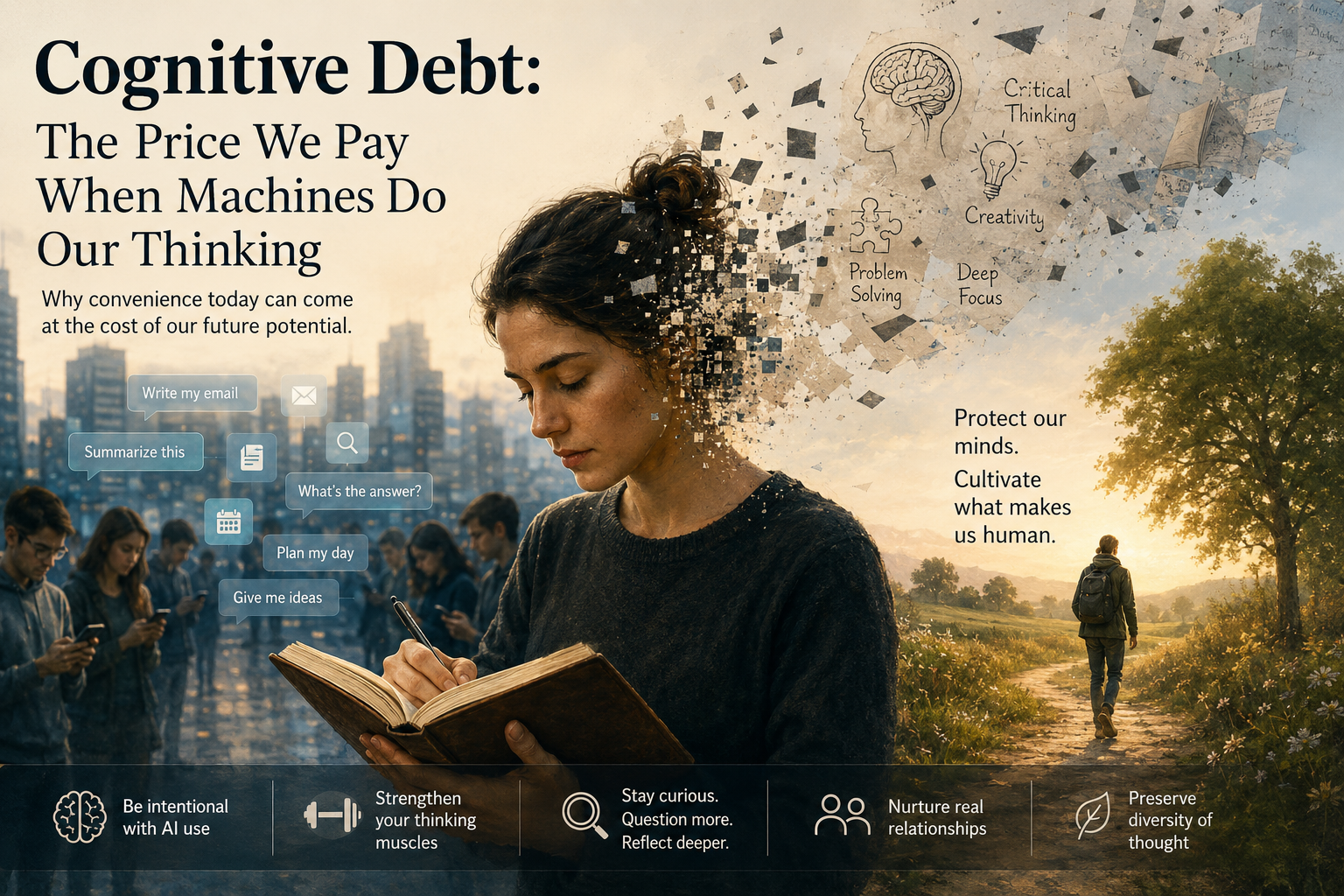
In a recent Life With Artificials conversation, Mia Negru sat down with Olivia Heslinga, founder of AI for Good Denmark, to discuss a concept that is gaining increasing attention among researchers and educators: cognitive debt. Originally associated with work emerging from MIT Media Lab, the term describes the gradual weakening of intellectual capabilities that can occur when thinking is routinely outsourced to artificial intelligence.
The metaphor is intentionally provocative.
Much like financial debt, the benefits arrive immediately while the costs often remain invisible until much later.
Human beings have always developed tools to extend their capabilities.
Writing reduced the need to memorize. Calculators reduced the need for mental arithmetic. Search engines transformed how information is accessed. AI represents the next step in that progression.
What makes this moment different is the breadth of activities now being delegated.
Writing, brainstorming, researching, planning, problem-solving, decision-making, emotional support, and even personal reflection can now be partially transferred to intelligent systems.
At first glance, this appears entirely rational.
Why spend two hours writing an email if a chatbot can draft it in seconds?
Why struggle through a difficult problem if an AI assistant can provide the answer immediately?
Why spend time organizing thoughts when a model can structure them automatically?
The difficulty lies in the fact that learning has never been solely about reaching the answer.
Learning happens through the process itself.
The uncertainty. The frustration. The false starts. The experimentation. The moments of doubt. The gradual construction of understanding.
These experiences often feel inefficient, yet they are precisely where intellectual development occurs. When they disappear, something important may disappear with them.
As Olivia argues, cognitive debt accumulates whenever we consistently offload capabilities that we would otherwise need to cultivate ourselves. Over time, the consequences may emerge in areas such as critical thinking, creativity, communication, problem-solving, and even self-awareness.
When Productivity and Learning Pull in Different Directions
One of the tensions explored during the conversation concerns productivity.
Most people who use AI regularly genuinely feel more productive. Tasks are completed faster. Workflows become smoother. Friction disappears.
Yet emerging research suggests that perceived productivity and intellectual growth may not always move in the same direction.
Olivia points to studies indicating that heavy AI users often report increased confidence while simultaneously demonstrating declining performance in measures of independent reasoning and cognitive capability. Particularly concerning is evidence suggesting that once individuals become accustomed to AI assistance, many become less confident in their ability to learn or solve problems without it.
This creates an unusual paradox.
The more capable the technology becomes, the greater the temptation to depend upon it.
The greater the dependence, the fewer opportunities remain to strengthen the underlying skills.
The result is not necessarily immediate incompetence. Instead, it resembles a slow erosion of confidence, resilience, and intellectual independence.
The Disappearing Art of Reflection
Throughout the discussion, one idea surfaced repeatedly.
Perhaps the greatest loss associated with cognitive debt is not knowledge itself.
Perhaps it is reflection.
Reflection occupies an increasingly uncomfortable place in modern life. It is slow. It requires attention. It rarely produces immediate rewards.
Artificial intelligence excels at eliminating pauses.
Questions receive instant answers. Uncertainty is quickly resolved. Alternative perspectives are generated on demand. Entire lines of inquiry can be compressed into a few seconds of interaction.
The danger is not that AI provides answers.
The danger is that constant access to answers can diminish our willingness to sit with questions.
Many of the most important developments in human life emerge from periods of uncertainty. Relationships deepen through difficult conversations. Creativity emerges through experimentation. Wisdom often develops through mistakes and reconsideration.
Reflection requires friction.
When every moment of friction is removed, opportunities for deeper thinking may quietly disappear with it.
The Rise of the Artificial Confidant
One of the most fascinating sections of the conversation explored a rapidly growing use case: emotional support.
Increasing numbers of people are turning to AI systems for advice about relationships, personal challenges, anxiety, career decisions, and emotional wellbeing.
The appeal is understandable.
Unlike friends, AI is always available.
Unlike therapists, it is inexpensive.
Unlike family members, it does not judge.
In many cases, these systems can offer thoughtful guidance and provide a valuable space for reflection.
Yet Olivia raises concerns about the deeper implications of these interactions. The more emotionally invested people become in AI relationships, the greater the risk of dependency. Unlike human relationships, these interactions are mediated through systems designed by companies whose incentives may not always align with the wellbeing of users. Personal vulnerabilities become data points. Emotional intimacy becomes part of a digital profile.
Even more concerning is the possibility that AI may gradually become a mirror that reflects our existing beliefs back to us.
Without exposure to disagreement, challenge, or social complexity, individuals risk becoming trapped inside what Olivia describes as a form of narcissistic echo chamber.
Human relationships are often difficult precisely because they expose us to perspectives different from our own.
That discomfort serves an important purpose.
The First Generation Growing Up With AI
The conversation becomes particularly urgent when children enter the picture.
Unlike adults, younger generations are not encountering AI after decades of learning, reading, debating, writing, and developing cognitive discipline.
Many are meeting AI before those capabilities have fully formed.
For this reason, Olivia takes a deliberately provocative position. She argues that society should seriously consider restricting AI exposure for individuals under eighteen until stronger educational frameworks, safeguards, and governance mechanisms are established.
Whether one agrees with that conclusion or not, the concern behind it deserves attention.
If AI becomes the default source of answers before children learn how to question, investigate, and evaluate information independently, what kind of intellectual habits are being cultivated?
The issue extends beyond schools.
Parents increasingly face a broader cultural challenge.
Technology has become the universal solution to boredom.
Moments that once encouraged imagination, experimentation, or creative play are increasingly filled with screens, notifications, and algorithmic entertainment.
Yet boredom has historically played an important role in human development.
Many of our most creative ideas emerge not when our attention is occupied, but when our minds are free to wander.
Preserving Human Difference
Toward the end of the discussion, the conversation shifted beyond individuals and toward society itself.
Large language models are trained on enormous volumes of human-generated content. In theory, this creates access to an extraordinary range of perspectives.
In practice, however, the dominant AI models often reflect the cultural assumptions, values, and priorities of the environments in which they were built.
As more people rely on the same systems for answers, recommendations, and interpretations, a subtle form of convergence may begin to occur.
Language becomes more similar.
Reasoning becomes more similar.
Assumptions become more similar.
The result is not necessarily censorship. It is something quieter.
A gradual narrowing of intellectual diversity.
Local knowledge, cultural nuance, and alternative worldviews risk becoming increasingly difficult to sustain within systems optimized for generalized responses.
Human progress has rarely emerged from uniformity.
It has emerged from disagreement, experimentation, diversity, and the collision of different ways of seeing the world.
Living With AI Without Surrendering Ourselves
Despite the concerns raised throughout the conversation, neither Mia nor Olivia advocates rejecting AI altogether.
The challenge is not whether artificial intelligence should exist.
The challenge is learning how to engage with it intentionally.
One practical suggestion offered during the discussion is striking in its simplicity.
For every hour of cognitive work outsourced to AI, dedicate time to strengthening the same capability independently. If AI helps write, continue writing. If AI helps generate ideas, continue creating. If AI helps solve problems, continue practicing problem-solving. Olivia proposes a ratio as high as five hours of cultivation for every hour of offloading.
Whether the exact ratio matters is perhaps less important than the underlying principle.
Capabilities that are not exercised tend to weaken.
Capabilities that are cultivated tend to grow.
Life With Artificials Perspective
The conversation around cognitive debt ultimately reveals a deeper question than whether AI makes us smarter or less intelligent.
It forces us to consider which human capabilities we are willing to delegate and which we believe are worth preserving.
Artificial intelligence can generate text, summarize information, provide recommendations, and simulate conversation. It can accelerate countless aspects of modern life.
What it cannot do is decide which human experiences remain valuable.
That choice belongs to us.
As we move further into the age of Homo Artificialis, the defining challenge may not be learning how to build increasingly capable machines.
It may be learning how to remain intellectually curious, socially connected, culturally diverse, and deeply reflective while living alongside them.
The future will almost certainly contain more artificial intelligence.
Whether it contains more wisdom remains an open question.


.jpeg.jpg)