A New Divide Is Emerging
One of the most interesting observations from Kristoffer's research is that AI appears to be amplifying existing differences among students.
Some students arrive with strong academic foundations, curiosity, digital confidence, and a genuine interest in understanding how new tools work. They experiment, compare models, watch tutorials, refine prompts, and continuously improve their workflows. AI becomes an extension of their existing learning habits, helping them produce more sophisticated work and explore ideas more deeply.
At the opposite end are students who remain skeptical of AI or avoid it altogether. Some fear accusations of cheating. Others simply prefer traditional methods or distrust the technology.
Between these groups sits a much larger population. These students use AI regularly, but often with a very different objective. Their goal is not necessarily to deepen understanding or challenge their thinking. More often, they are looking for efficiency, convenience, and faster completion of assignments.
For educators, this creates a fascinating challenge.
The technology itself is becoming widely accessible. What remains unevenly distributed is the knowledge required to use it well.
As Kristoffer describes it, the real differentiator is no longer access to AI. Increasingly, the differentiator is AI literacy.
When Convenience Replaces Reflection
Throughout the conversation, one concern surfaced repeatedly.
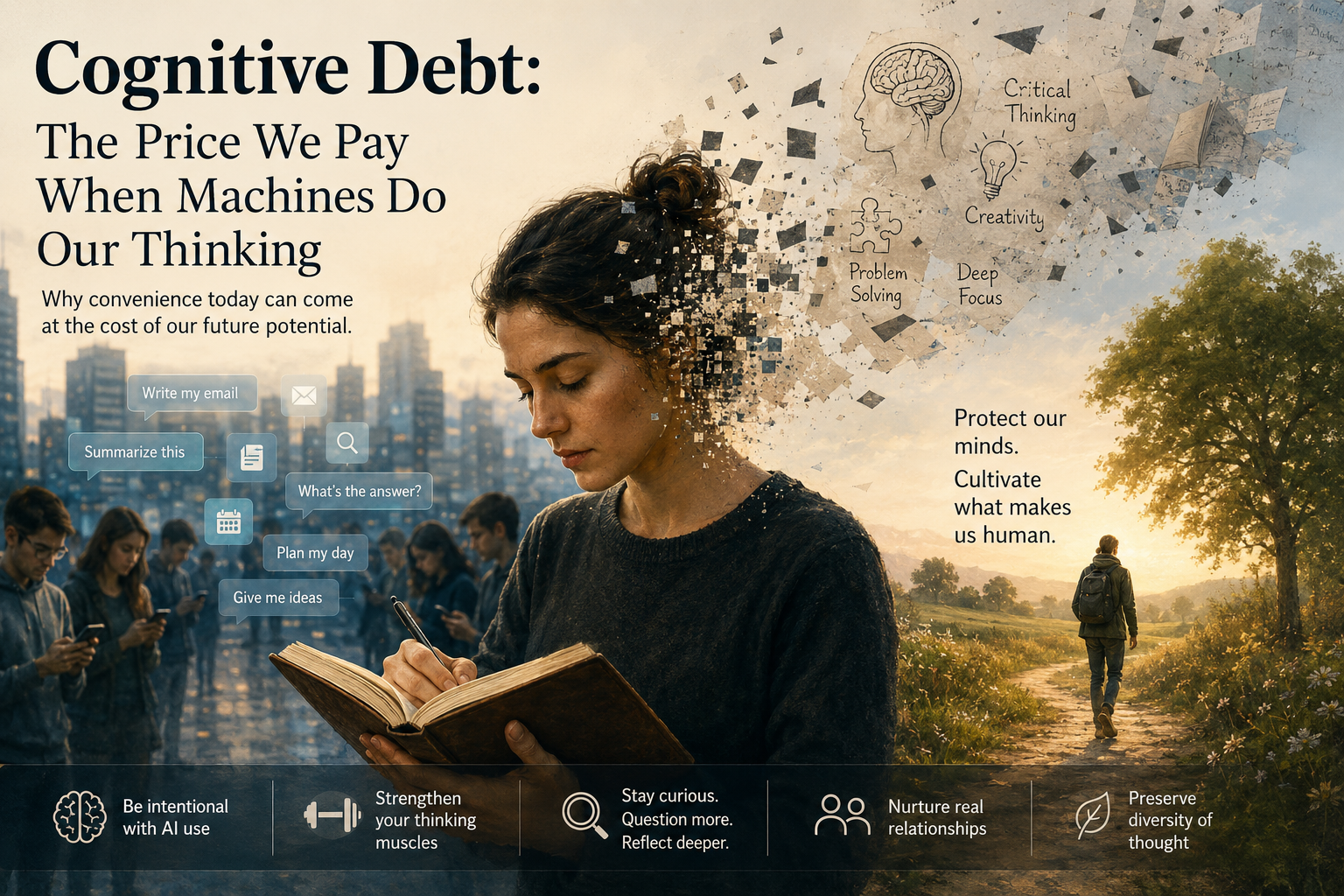
The challenge facing education does not arise because students can use AI. The challenge emerges when students begin to bypass the very cognitive processes that education is designed to cultivate.
Most educators are familiar with examples of students submitting work they barely understand. Sometimes the signs are obvious. An assignment may contain text far beyond the student's demonstrated capabilities. In extreme cases, students even forget to remove prompts or instructions generated by the AI itself.
These examples are easy to spot.
The more interesting question lies beneath them.
What happens when students become accustomed to receiving answers before they have wrestled with the problem?
Learning has always involved uncertainty. It involves confusion, frustration, experimentation, mistakes, and gradual discovery. Those moments often feel inefficient, but they are precisely where intellectual growth occurs.
If every challenge is immediately outsourced to an AI system, there is a risk that students become highly capable at producing outputs while remaining disconnected from the reasoning that produced them.
This concern connects closely with another theme frequently explored by Life With Artificials: cognitive depth.
The future may not belong to those who can generate the most content. It may belong to those who retain the ability to question assumptions, evaluate evidence, recognize uncertainty, and think independently in collaboration with intelligent systems.
Why Banning AI Is Unlikely to Work
As schools around the world struggle to respond, many have experimented with restrictions.
Some institutions have banned AI tools. Others have limited access to devices. In several countries, debates continue around restricting phones in classrooms.
Kristoffer argues that these approaches may address symptoms without addressing the underlying challenge.
Students are remarkably resourceful. New tools appear faster than educational policies can adapt. Even sophisticated technical restrictions are often bypassed within days.
Rather than engaging in an endless arms race with technology, he suggests focusing on a different question:
How can students demonstrate responsible and thoughtful use of AI?
Imagine an assignment where students are expected to document their process. They show the prompts they used, explain how they evaluated the responses, identify where the AI was helpful, and describe how they arrived at their final conclusions.
Under such a framework, the educational value no longer resides exclusively in the final answer. Greater attention is paid to the quality of judgment, reasoning, and decision-making demonstrated throughout the process.
For many educators, this may represent a more productive direction than attempting to eliminate AI from learning environments altogether.
The Teacher's Role Is Changing
For centuries, teachers served as primary gatekeepers of knowledge.
Today, a student can access more information in seconds than previous generations could access in months.
This reality does not diminish the importance of educators. It transforms it.
In the future envisioned during the conversation, teachers spend less time transmitting information and more time helping students navigate complexity.
Their role increasingly resembles that of a coach, mentor, guide, and critical thinking partner.
Rather than evaluating whether students can reproduce information, educators may focus more heavily on how students formulate questions, interpret evidence, solve problems, and communicate ideas.
The classroom becomes less focused on memorization and more focused on inquiry.
The educational experience becomes less about navigating a fixed curriculum and more about developing the intellectual capabilities required to navigate a rapidly changing world.
The Opportunity Hidden Within Neurodiversity
One of the most hopeful moments of the conversation emerged when discussing neurodiversity.
Traditional educational systems were designed around standardization. Students were expected to sit still, absorb information in prescribed ways, complete similar assignments, and demonstrate knowledge through standardized assessments.
For many learners, that model worked reasonably well.
For others, it created barriers.
Students with dyslexia, ADHD, autism, and other forms of neurodivergence often found themselves navigating systems that were not designed around their strengths.
Artificial intelligence introduces a fascinating possibility.
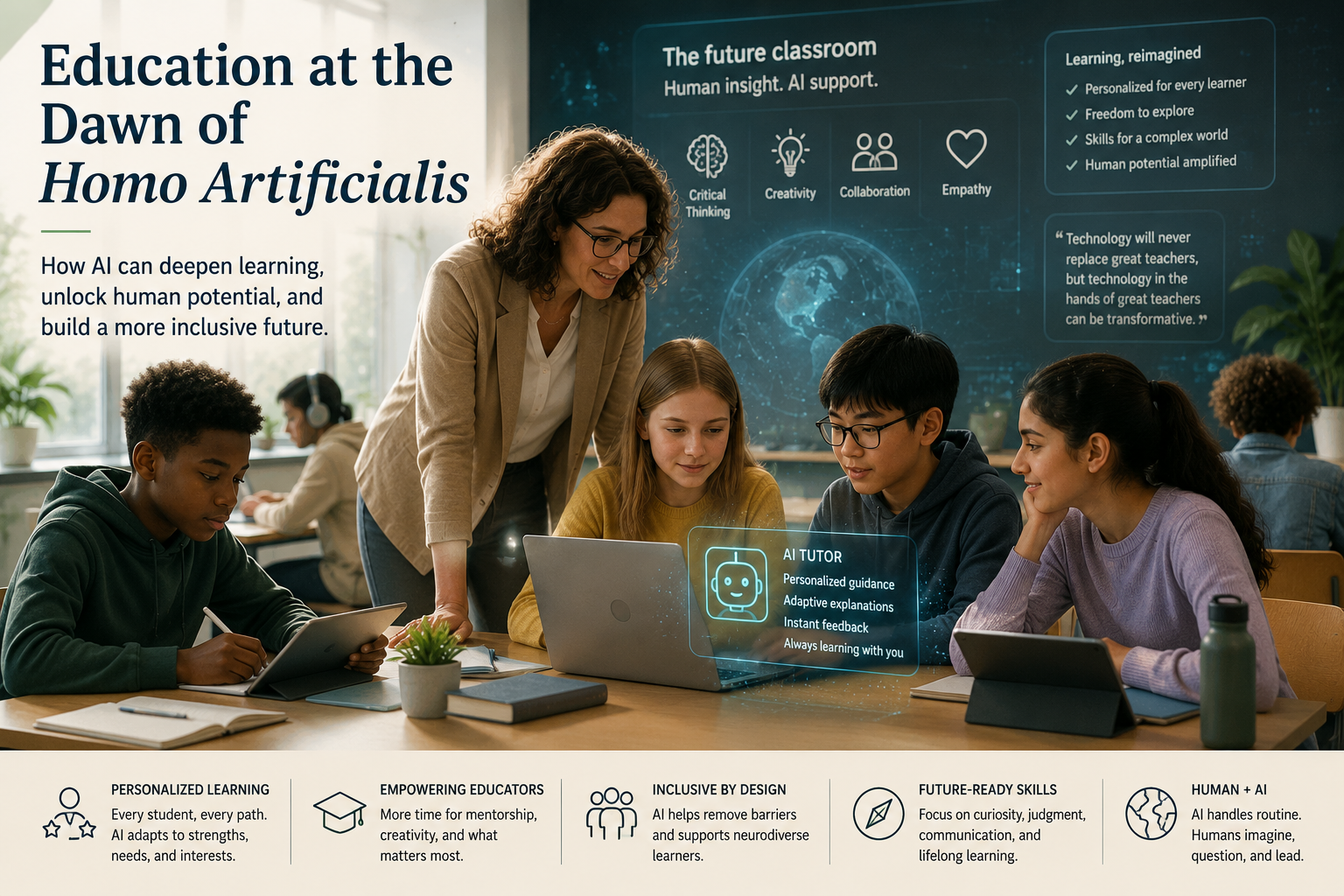
For the first time, educational support can become highly personalized.
An AI tutor can explain the same concept in multiple ways. It can adjust its communication style. It can provide immediate feedback. It can answer the same question one hundred times without frustration. It can adapt to different learning preferences and cognitive styles.
What has historically been perceived as a limitation may increasingly be recognized as a source of strength.
Kristoffer suggests that many neurodivergent individuals may be particularly well positioned to thrive in an AI-enabled future precisely because they often approach problems differently.
In a world where routine tasks become increasingly automated, originality, creativity, alternative perspectives, and unconventional thinking become more valuable.
The qualities that once made individuals stand out in classrooms may become some of the most sought-after capabilities in society.
Imagining the Future Classroom
At Life With Artificials, we often explore possible futures.
When applying that lens to education, a compelling image begins to emerge.
A child enters school accompanied by a personalized AI tutor that understands their strengths, challenges, interests, and learning preferences.
Lessons adapt dynamically.
Students move at different speeds without stigma.
Creative projects become increasingly ambitious because learners have access to powerful cognitive support.
Teachers focus on mentorship, collaboration, emotional development, ethics, and critical thinking.
Students spend less time memorizing information that machines can instantly retrieve and more time exploring questions that have no obvious answers.
Learning becomes more personal, more exploratory, and perhaps more human than many educational systems have allowed.
Building the Framework Together
Despite the optimism, one challenge remains clear.
Technological development is moving significantly faster than educational governance.
Educators are being asked to make decisions while the tools continue to evolve at extraordinary speed. Institutions often find themselves creating policies in real time, without clear guidance from governments or regulatory bodies.
This creates uncertainty for teachers, students, and families alike.
Rather than imposing solutions from a distance, the conversation highlighted the importance of bringing educators, researchers, policymakers, technology developers, students, and industry representatives together.
The future of education should not be designed for those who experience it.
It should be designed with them.
Life With Artificials Perspective
The emergence of artificial intelligence in education forces us to revisit a question that is much older than technology itself:
What qualities do we hope education cultivates in human beings?
If learning has simply been the transfer of information, then increasingly capable AI systems may seem threatening.
If learning is understood as the development of judgment, curiosity, creativity, resilience, empathy, and wisdom, then the picture changes considerably.
In that future, artificial intelligence becomes less interesting as a source of answers and more interesting as a catalyst for human growth.
The students who flourish may not be those who rely most heavily on AI. They may be those who learn how to think alongside it without surrendering their own agency.
As we move toward what Life With Artificials describes as the age of Homo Artificialis, education finds itself at the center of one of society's most important experiments.
The question is no longer whether artificial intelligence will become part of learning.
The question is what kind of humans we hope to become while learning with it.

.jpeg.jpg)